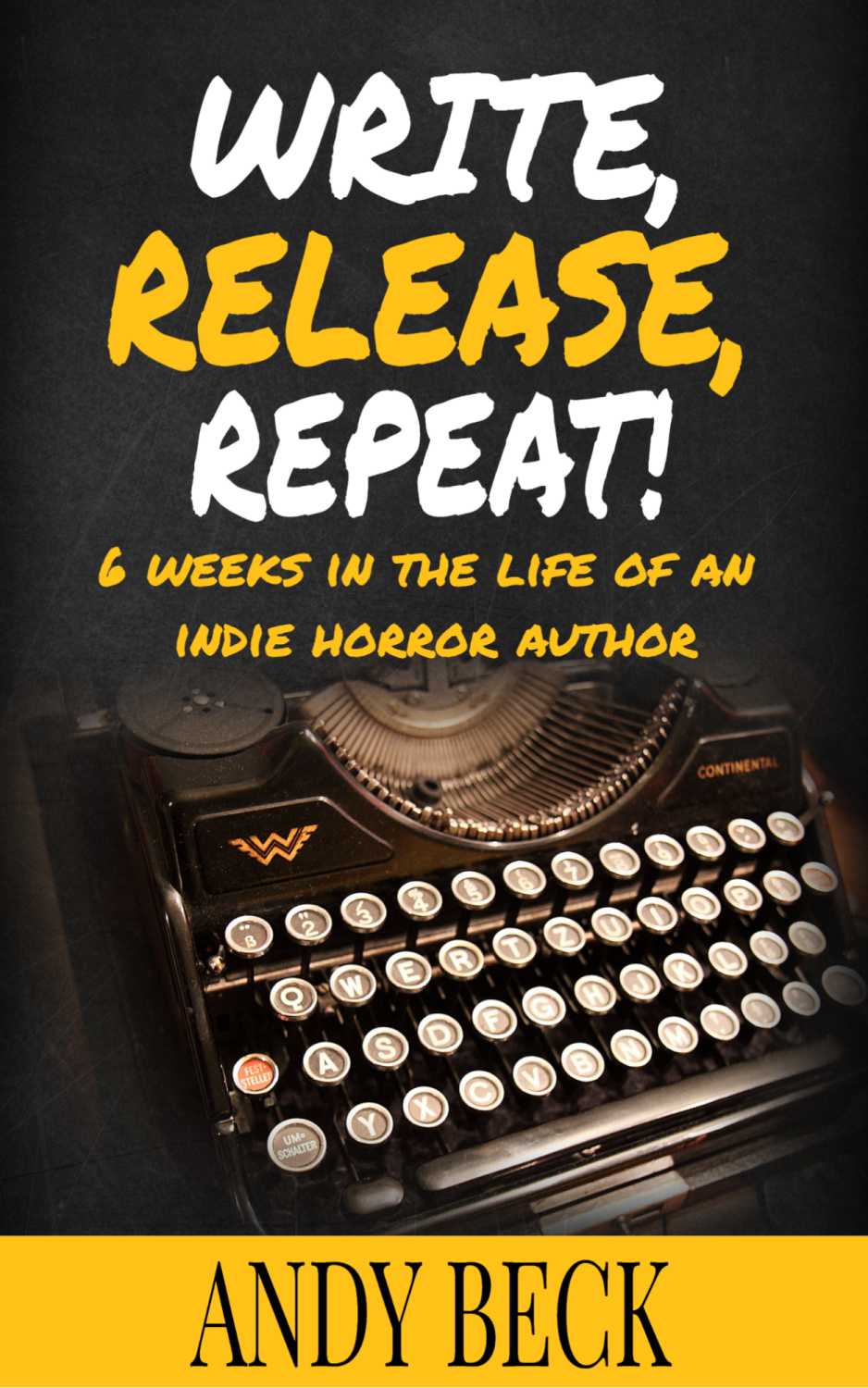
Write, Release, Repeat! 60 days in the life of a horror author.
It’s just gone live on Amazon and as you might guess from the title, it isn’t fiction. It’s been a labour of love and hate. Parts of it were very easy to write and parts of it were incredibly painful. I talk about everything from Safe Haven to inspiration to coping with loss. You’ll be able to read about the huge gambles I’ve taken, the massive mistakes I’ve made and how I managed to keep going when I thought my world was falling apart around me.
Yep, it’s a bit different from my usual subject matter, isn’t it? Well, so you can get an idea as to whether it’s your cup of tea or not, I’m including an entry from it at the end of this post.
For those of you who’ve already decided to give it a go, you can get your copy from Amazon now. For those who want to try before you buy, hopefully you’ll enjoy the excerpt.
SPOILER ALERT! SPOILER ALERT! SPOILER ALERT!
Spent very little time at the laptop yesterday and felt better for it. Did some stuff in the tunnel, cooked a nice Italian meal while chilling out to some John Coltrane and in the evening watched one of the most remarkable pieces of filmmaking I’ve ever seen. For Sama, by Waad Al-Kateab. It was a kind of diary that a mother made for her daughter so she could see the atrocities and hardship that surrounded her early life in Syria during the rebellion. It was both inspiring and devastating. I was pretty much breaking down in tears every few minutes and if you take the 96 minutes to watch it, you’ll understand why.
One of the greatest compliments I get paid as an author is when someone tells me that my books made them cry. That sounds a bit weird, but it’s true. If the character I have created and the words I’ve written can evoke such a powerful response, that’s a big deal as far as I’m concerned. It means that I’ve forged an emotional connection with someone who could conceivably be living on the other side of the world.
If you’re not familiar with my work and scoff at the thought of someone crying at a zombie or horror book, I get it. So, I’ll explain as concisely as possible about one of the main things that drives me to write.
I enjoy the types of books I write because in the darkest times, you get to see the best and the worst of human nature. We all have the potential to be heroes or villains and sometimes to be one or the other simply comes down to falling in with the wrong crowd due to your own fears and insecurity.
In some of my books, ordinary people have partnered with monsters because they believed it was the best way to protect themselves and their loved ones. Little by little, they become more insidious, more monstrous themselves by association. They backed the wrong horse and rather than tearing up the betting slip and walking away, they double down. One bad choice could be the difference between light and dark.
Likewise, other characters, whether librarians or retail workers or home helps, ordinary salt-of-the-earth people with no particular skill set to survive in apocalyptic or terrifying situations, become extraordinary by throwing in with those who allow their moral compass to navigate life for them. The kind of people who always try to put the greater good before themselves.
I’ve boiled that down very simplistically. There are lots of shades of grey in between, but in essence, what I’m saying is that the horror is a vehicle for me rather than being the destination. It’s the characters that I’m interested in and that’s been the case ever since I first wrote Rise of the RAMs.
With each line, each paragraph, each page, the characters develop. They become a little more human. They’re characters on the page, but they’re real in my head and I see it as my job to make them real in other people’s heads too. They’re born from my life experience, my observations. When one of my characters mourns a loss, my brain puts me in their mind and I feel the loss just as acutely as I do when someone close to me dies. Dealing with loss is a very complex process and there’s no way it can be conveyed in a couple of paragraphs on the page, but there are takeaways from experiences I’ve had that will probably resonate with a lot of my readers and subsequently elicit a powerful response.
I was 19 when my dad died. He had cancer and we’d been told it was just a matter of time. We had him at home and he went into a long, morphine-induced sleep. My mum, my brother and I took it in turns to sit by his bed, but I was the one sitting there when it happened. I’d always had a difficult relationship with my dad. He was someone who wasn’t cut out for fatherhood, but I loved him. There were things about him that I admired and one of the most resonating was how he fought against the cancer that was eating away at him. In those last few months, I think I got to see the man he truly was underneath.
I remember the death rattle. That’s actually a thing for anyone who wonders. It’s a long, drawn-out intake of breath, and you don’t know it’s the death rattle at that moment. But when nothing comes after. When there’s no follow-up exhalation, you realise.
I watched and listened, not believing this was it, not believing I was the one on shift when this happened, not believing I would have to be the one to tell Mum, who was busy in the kitchen downstairs. I ended up telling my brother first and we both broke the news.
The sound of despair that rose from Mum was something I will never forget. It was shrouded in the word “No,” which she repeated over and over again. It’s a short, simple word, but that afternoon it held many meanings.
No. You must have made a mistake.
No. I can’t believe he’s gone.
No. It should have been me who was there for his last breath.
No. I don’t want to have to face this.
No. I don’t want to be alone.
No. I still had things I wanted to say.
Fast-forward nearly twenty years and we had to make a mad dash from the Isle of Lewis, driving through the night to get to my mum’s hospital bed. This time, the whole extended family was there and the staff had given us an empty room where we could sleep in shifts on the floor. The NHS is arguably one of the greatest institutions in the world, staffed by heroes at ground level. I will always rail against any opportunistic little parasites who want to carve it up and sell it off to the big insurance companies. As painful as that whole thing was, it gave me incredible comfort to know that a woman who had lived in council houses for most of her life was getting better care than money could buy.
It didn’t make it easier to watch her last few hours though. It was the middle of the night and I was there with my auntie.
When it happened. When my mum took her last breath, that same word screamed in my head.
It echoed in my skull as if it were being broadcast through a loudspeaker.
But this time, I understood things a little better. I understood that one of those no’s was directed towards me. One of those no’s was because the tiniest, tiniest part of me was relieved. Throughout her last hours, the suffering present on my sweet mum’s face was almost biblical. To watch someone you love going through that is gut-wrenching and even though dying was the last thing I wanted her to do, when it came, it meant that she wasn’t going through that torment any longer. So as well as anger, grief, denial and everything else I was going through, there was also a tiny part of me that was grateful too. And I really couldn’t help feeling guilty for that.
So again, NO was the word of the moment as it was with every significant loved one I’ve lost. No pretty much encapsulates those first seconds, those first moments. No was for Hollie, Fred, Wilma, Lola, Humph and Daisy. No was for all the pain and all the regret and all the what-ifs. It’s a word that means one thing and means many things and if it’s framed in the right way on the page, it can convey so much.
It’s from all those experiences that I draw when I’m dealing with a character’s death, and no is always the kick-starter.
So, when someone tells me that I’ve made them cry, it’s as if I’ve got them to live through a little bit of the suffering I’ve lived through. It’s as if I’ve built a bridge between them and me for just a short time, and that is an incomparable feeling and one of the greatest privileges I experience as a writer.
I always get emotional when I lose an established character. I don’t want to give away any spoilers, so I’m not going to talk about specific ones, but there have been tears. Lots and lots of tears. I think it’s my duty to mourn them. I draw on my own experiences to give the story weight and along the way, I’ve learnt to bombproof myself a little bit. I’ve found a manageable trauma zone to work in so I don’t spiral every time it comes to writing about death and loss. Alas, there’s no such safe haven for me when it comes to life beyond the page.
Well, I didn’t expect to be talking about all of this on my day off. I’m guessing For Sama resonated with me more than anything I’ve seen in a long time. Undoubtedly, the pain and horror that’s memorialised in the film will somehow weave its way into the tapestry of death that’s become my emotional reference library for when I’m writing, but for now I see it just as a really brave and powerful piece of filmmaking that I wish I’d seen when it first came out. A big thank you to Waad Al-Kateab for sharing something so powerful, beautiful, brutal and devastating.
© Christopher Artinian Publishing 2026
https://mybook.to/Write